Rituals, Attention, and Meaning
Photo by Matt Baron-Thompson on Unsplash
Ritual transforms the everyday into something sacred through intention and attention. By directing our awareness and presence, we weave meaning into ordinary moments, and make meaning of the larger times of passages. We do ritual to mark what matters—to honor transitions, hold grief and gratitude, and meet our lives with presence. In Rituals in Buddhism, Gil Fronsdal writes that “rituals are a form of language that expresses many dimensions of our human condition, including our relationship to others and to our spiritual life” and that they can be “as ordinary as greeting people with a handshake and as extraordinary as an elaborate memorial ceremony that brings healing to grief. Rituals can transform the ordinary into something extraordinary.” That idea has stayed with me because it names something I have come to understand: ritual is not separate from life, but one way of meeting it more fully.
When I entered the eco-chaplaincy program, one of my most immediate insecurities was facilitating ritual. I worried that I did not know enough, or that ritual required a kind of authority I did not have. But the longer I have spent paying attention to ritual, the more I see how I have already been marking thresholds with my attention, already offering gratitude and bringing my presence to make meaning. Ritual is not something outside of my life, but already woven into it.
Rituals that have stayed with me
When I moved from Seattle to Portland several years ago, a close group of friends came to my empty apartment with blankets, dried flowers, and their songs, holding me with a tenderness that is still alive in my body. In the middle of their circle, they covered me from head to toe with flowers and sang me songs of being held by the Earth. I remember feeling the ache of a chapter ending, the gratitude of having been held by that apartment and time, and the deep comfort of being lovingly ushered into what would come next. It was simple, beautiful, and unforgettable.
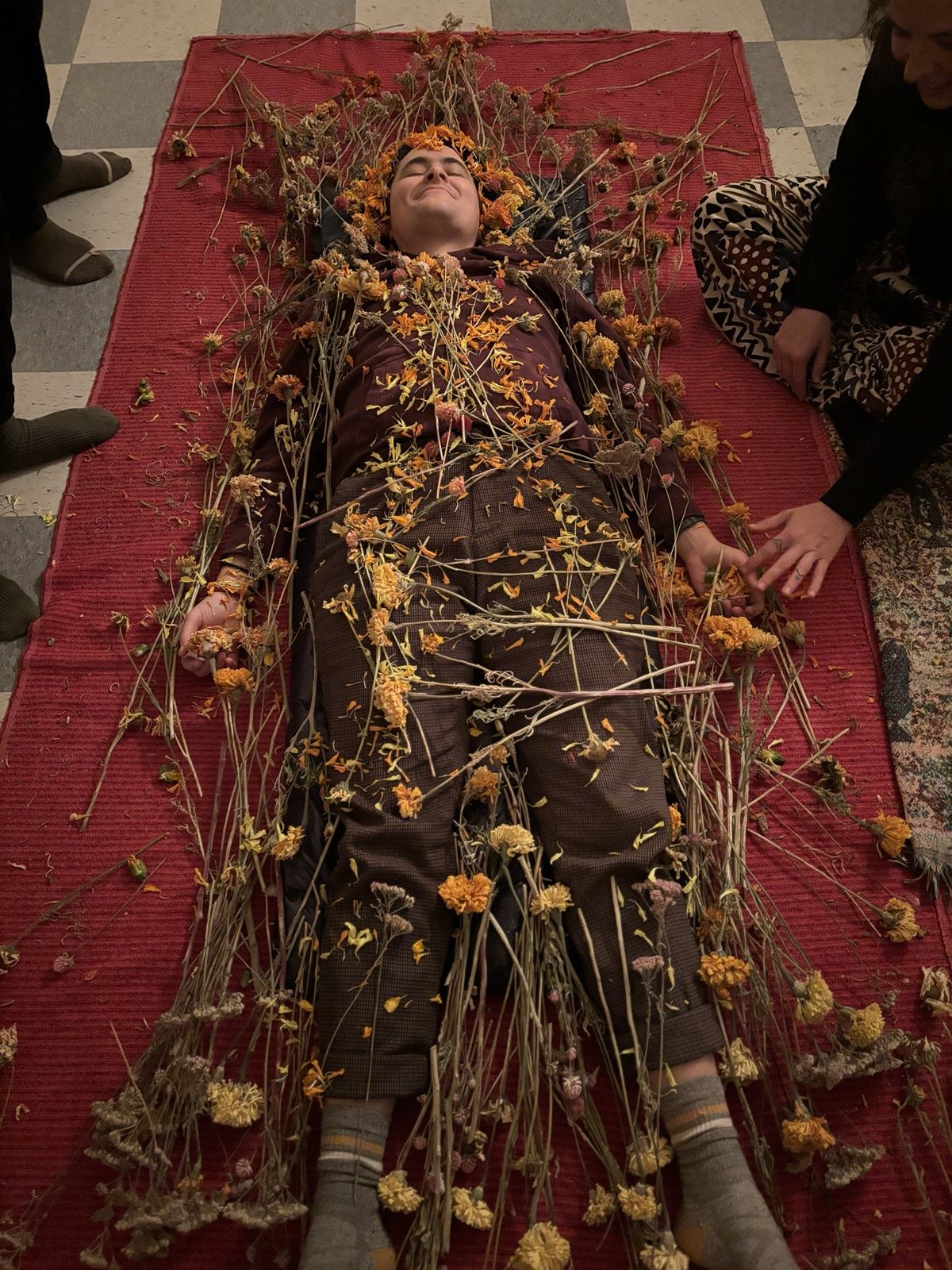
Photo by Easton Brannam
Another ritual that remains with me came during a death contemplation retreat. Each morning, waking with the sun felt like a fierce and tender act of gratitude. I recall the astonishment and joy of recognizing my first breath of the day, another day that I am alive. Each evening, I laid my body on the Earth in gratitude for the day that had passed in acknowledgment of the uncertainty of the next. A reminder that every breath is worthy of reverence, and at some point these precious breaths will end for each of us.
I have used ritual as a way of being with shame, an emotion that has followed me closely in life. I cut off locks of my hair, breathed this shame stored in my body into it, and buried it in the backyard. I called ancestors into the funeral with me, placing rocks for each person tied to the shame. For months after, I returned to the stones that marked the grave and sang of gratitude, asking the Earth and soil to help carry, transform and release.
A Ritual for Solstice
One of the beautiful gifts of our Buddhist Eco-Chaplaincy Association is our seasonal Community of Practice, where rotating facilitators offer ceremonies and rituals that honor the changing seasons. This month, I had the joy of working with a fellow eco-chaplain to design our summer solstice ritual.
As Gil Fronsdal describes in Rituals in Buddhism, rituals typically have a beginning, a middle and an end. In the beginning we might set the stage by stating intentions, bringing in objects, and generally shifting our attention towards the sacred. The middle of a ritual is a period of transition, a liminal space where we are “open and willing to hear or do something different.” This middle phase is where the main purpose of the ritual is carried out, whether it's setting an intention, offering a blessing or marking a transition. The ending of a ritual can be as simple as a bow, but it’s important to mark this closing with some piece of intentional integration.
Photo by Aaron Burden on Unsplash
In our summer solstice ritual, we opened with a short story of visiting an ancient construction in Mexico that was built to align with the solstice sun opening and directing light at an exact point through a portal. This was our inspiration for the ritual, and the context in which we were inviting people in. We shifted our attention together in a guided meditation bringing the power and warmth of the sun into our bodies. Participants were asked to locate what in themselves could benefit from this directed luminosity and nourishment. The middle of the ritual had each of us placing an item that represents abundance on our community altar while speaking aloud where each of us is bringing sunlight and growth to within ourselves. We ended the ritual by sending this light out to all beings. This was marked by lighting a candle and blowing it out, imagining this light with us continuing and emanating out.
What I love about this ritual is that it does not require elaborate supplies or a perfect script. It asks only for presence, willingness, intention and some structure. If you want to create a ritual of your own, you might begin with one breath, one candle, one song, one object, or one question. What are you entering? What are you leaving behind? What do you want to call in?
Learning to Trust Ritual
For a long time, I felt intimidated by the idea of facilitating ritual and ceremony. I thought it had to be formal, that I had to have an authority given to me in order to facilitate community ritual. But I have come to see that ritual is often already happening in the smallest of ways– the first breath in the morning, a song, flowers being placed intentionally, in acknowledging a seasonal change– and that it belongs to each of us. You don’t need to be granted a privilege of making a ritual, it’s already there waiting for you.
This is what I want to offer others: the reminder that ritual does not have to be elaborate. It can be as simple as your attention and intention. My invitation is to notice rituals already in your life, and to expand them gently, invite others in. What do you already do to mark a beginning, honor an ending, or move through change? Where is the ceremony already waiting to be recognized? Often, it is closer than we think- already present, already sacred, waiting only for our attention.